
Local SEO Service for Small Business How to Get Found by Customers Near You in 2026
What Is Local SEO for Small Business?
Local SEO Service for Small Business is the process of optimizing a business’s online presence so it appears in location-based search results — things like “plumber near me,” “best pizza in [city],” or “accountant [neighborhood].” For small businesses, it means showing up when a nearby customer is actively looking for what you sell.
It covers three main areas: your Google Business Profile, your website’s on-page signals, and mentions of your business name, address, and phone number (NAP) across the web. Done right, local SEO puts your business in front of people at the exact moment they’re ready to buy — without paying per click.
The difference between local SEO and general SEO is intent and geography. General SEO tries to rank for broad terms nationally. Local SEO targets a specific city, town, o
How Local SEO Works: The Three Core Ranking Factors
Google uses three primary signals to decide which local businesses to show for any given search.
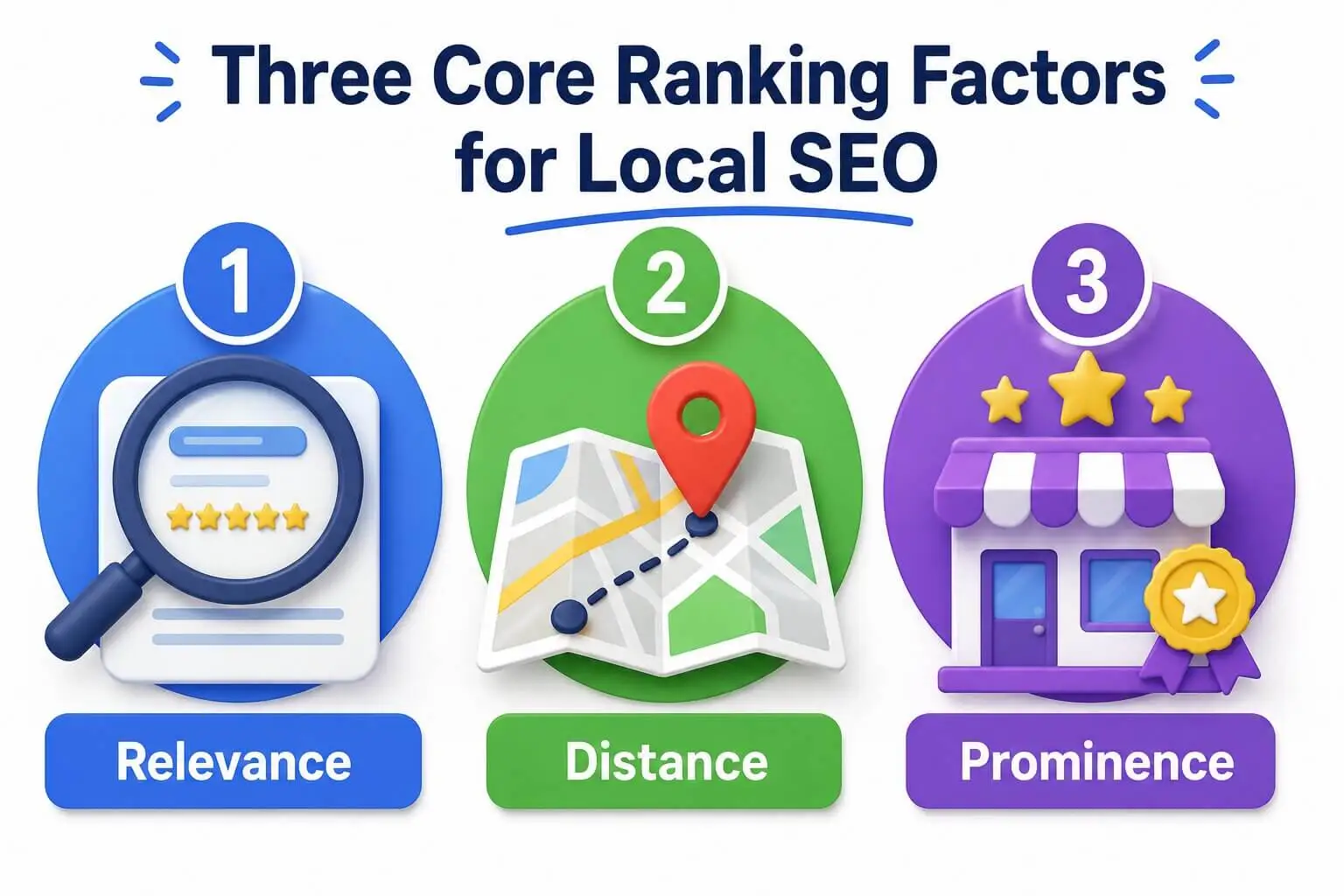
Relevance measures whether your business matches what the searcher needs. If someone searches “emergency electrician,” Google looks at your service categories, website content, and Business Profile description to see if you’re an electrical contractor.
Distance is straightforward: Google estimates how far the searcher is from each business and factors that into rankings. This is why a business two miles away often outranks one that is technically more popular but eight miles farther.
Prominence reflects how well-known and trusted your business is online. This includes your review count, review ratings, backlinks from local websites, and citations (mentions of your business name, address, and phone number across the web).
When all three are strong, you appear in the “map pack” – the three business listings that appear above organic results. That placement gets a significant share of clicks for local searches.
Google Business Profile: The Most Important Local SEO Asset
Your Google Business Profile (GBP) is the single most impactful element in local SEO. It is the listing that powers both the map pack and the Knowledge Panel that appears when someone searches your business name directly.
A fully completed GBP can increase website visits by up to 70% and direction requests by 68% compared to incomplete profiles (Google, 2023). The most important fields to fill out completely: business category (choose the most specific one available), business description, services or products, hours, photos, and your phone number and address.
Post to your GBP at least once a week. Businesses that actively use Posts, Q&A, and the messaging feature see better engagement signals, which Google factors into rankings. Reviews matter enormously here – aim for a response rate above 90% and respond to negative reviews within 24 hours.
Local Citations: Why Consistent Information Across the Web Matters
A citation is any online mention of your business name, address, and phone number (NAP). Google cross-references your NAP data across dozens of directories to verify your business is legitimate and located where you say it is.
Inconsistent NAP data – for example, “Suite 4” on your website but “Ste. 4” on Yelp – creates conflicting signals that can suppress your rankings. A local SEO service audits and corrects these inconsistencies across the most authoritative directories.
The directories that carry the most weight for local rankings include Google Business Profile, Bing Places, Apple Maps, Yelp, Facebook, Foursquare, and industry-specific directories relevant to your niche (Moz, 2024). Getting listed on all of them with identical NAP data is called citation building.
On-Page Local SEO: What Your Website Needs
Your website needs to send clear geographic signals to Google. Without them, even a perfect Google Business Profile will struggle to rank competitively.
The four most important on-page local SEO changes for small businesses:
- Location page: Create one dedicated page per service area. The page title should follow the format “[Service] in [City, State]” – for example, “Roof Repair in Austin, TX.” Include your full address, a Google Maps embed, and at least 300 words of original content about that location.
- NAP in the footer: Your business name, address, and phone number should appear in the footer of every page, formatted consistently with your GBP.
- Schema markup: LocalBusiness structured data tells Google exactly what type of business you are, your hours, and your location in a machine-readable format. This can improve how your listing appears in search results.
- Page speed: Google uses page speed as a ranking factor. A site that loads in under 2.5 seconds (measured by Core Web Vitals) will outperform a slow competitor, all else being equal.
Reviews and Reputation: The Local Ranking Signal You Cannot Fake
Online reviews are the second most influential factor in local pack rankings, after proximity (Whitespark, 2024). More than that, 87% of consumers read online reviews for local businesses before making a purchase decision (BrightLocal, 2024).
The most effective strategy for generating reviews: ask at the moment of highest customer satisfaction. For a restaurant, that is at the end of a great meal. For a contractor, that is the moment the job is complete and the customer sees the result. Send a direct link to your Google review page via text or email – every step you remove from the process increases your conversion rate.
Never buy reviews or offer incentives in exchange for them. Google detects suspicious review patterns and removes entire review profiles as a penalty (Google Search Central, 2024).
Local Link Building: How to Earn Authority in Your Area
Backlinks from locally relevant websites tell Google that your business is trusted within the community. A link from the local Chamber of Commerce, a regional news outlet, or a neighborhood association carries far more local ranking weight than a generic directory link.
Practical ways small businesses earn local links:
- Sponsor a local event or youth sports team and request a link from their website
- Get featured in local news by pitching a story angle tied to your expertise
- Partner with complementary local businesses for cross-referral pages
- Write a guest post for a local business blog or community news site
For a structured guide to building local citations and links without paid tools, Whitespark’s Local Citation Finder is a reliable starting point used by thousands of small business owners.
What a Local SEO Service Does for Your Business (And What to Expect)
A professional local SEO service handles the technical, content, and authority-building work that most small business owners do not have time to do consistently. Here is what a reputable agency or consultant typically delivers each month:
- Ongoing Google Business Profile optimization and posting
- Citation audit and cleanup across 50 to 100+ directories
- Monthly on-page optimization of service and location pages
- Review monitoring and response management
- Local link building outreach
- Monthly reporting showing ranking changes, traffic, and call data
Results are not instant. Most small businesses see meaningful ranking improvements within 3 to 6 months of consistent work (Moz, 2024). Competitive markets – home services, legal, healthcare, restaurants in large cities – often take 6 to 12 months to crack the top three map pack positions.
Why Choose Foridul Islam for Your Local SEO
Here is the direct answer you should hire Foridul Islam if you want results explained in plain language, strategy built around your specific market – not a copy-paste template – and consistent execution without locking you into a 12-month contract.
Most local SEO providers sell you a report. I build a ranking system. That means auditing what is actually holding your rankings back, fixing it in a documented and repeatable way, and showing you in monthly reports exactly which changes moved the needle. You will never receive a 40-page PDF full of green checkmarks that does not explain what happened to your leads.
My process starts with a free local SEO audit of your Google Business Profile, citations, and top three competitors. From that audit, you get a prioritized action list – the 20% of changes that will produce 80% of your results. If you decide to work together, we move straight to execution.
Frequently Asked Questions About Local SEO for Small Businesses
How much does it cost to hire an SEO expert?
Hiring an SEO expert costs between $75 and $200 per hour for freelancers, or $500 to $5,000 per month for agencies, depending on experience and scope. For local SEO focused on one or two service areas, most small businesses spend $300 to $1,500 per month with a qualified specialist.
How much should local SEO cost?
Local SEO for a small business typically costs $300 to $2,000 per month. Lower-competition markets and single-location businesses sit at the lower end. Businesses in competitive categories like personal injury law, HVAC, or dental care in large cities often need $1,000 or more per month to compete effectively.
What is the 80/20 rule of SEO?
The 80/20 rule in SEO means that roughly 20% of your optimization activities produce 80% of your results. For local SEO, that 20% is almost always Google Business Profile completeness, review generation, and NAP citation consistency. Getting those three right produces the majority of ranking improvements most small businesses will ever need.
Is it worth paying someone to do SEO?
Yes, for most small businesses, hiring someone to handle SEO is worth the cost if you are in a market where customers search online before buying. The time required to do local SEO correctly – ongoing GBP management, citation cleanup, link outreach, content updates – adds up to 10 to 20 hours per month. Paying a professional frees you to run your business while someone else builds your search presence.
How much does local SEO cost for a small business?
A small business with one location in a mid-competition market should budget $300 to $800 per month for a competent local SEO service. Businesses with multiple locations or operating in high-competition niches should budget $1,000 to $2,500 per month.
Is SEO worth it for a small business?
SEO is worth it for small businesses that rely on local customers finding them online. The average small business gets 28% of leads from organic search (BrightLocal, 2024), making it one of the top two lead sources alongside referrals. Unlike paid ads, SEO traffic does not stop when your budget runs out.
Is doing local SEO worth it?
Local SEO is worth it for any business that serves customers in a defined geographic area. The map pack and local organic results combined capture over 60% of clicks for location-based searches (SparkToro, 2023). If you are not in those results, you are invisible to the majority of nearby customers who are actively looking to buy.
How much does a local SEO cost?
A local SEO engagement typically costs $300 to $2,000 per month for ongoing services, or $500 to $3,000 as a one-time audit and setup project. The cost depends on market competition, the number of locations, and the scope of work – citation building alone versus full-service management including content and links.
How much should I expect to pay for SEO?
For local SEO specifically, expect to pay $300 to $1,000 per month if you are a single-location small business in a mid-competition market. For reference, the average cost of a new customer acquired through paid Google ads for local service businesses is $50 to $200 per lead (WordStream, 2024). Local SEO, once established, typically generates leads at a lower cost per acquisition than paid search.